
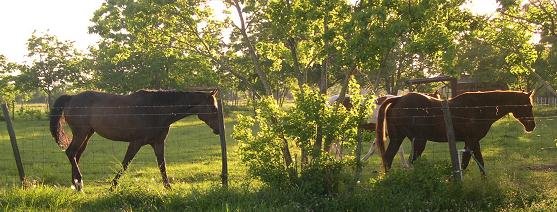
Welcome to the Cardinal Points Farm blog !
Dear friends and fellow animal lovers, here it is ... a blog for discussing animal training.
My specialty is horse training and riding dressage, but I’ve applied to my horses many invaluable lessons from dog trainers and dolphin trainers. Together we can create a greater awareness of the unlimited potential for greatness that your animals (and you) possess, once you acknowledge that animals are intelligent and capable of reasoning and communication.
So let’s get started ! Let's share insights, lesson plans, techniques, videos, pics, stories ... what have you.
Enjoy,
Sian Min The
Cardinal Points Farm
If you'd like to post your training stories, send your stories to me for consideration. Please specify how you'd like the attribution to read, i.e. your full name or your internet 'handle'.
My specialty is horse training and riding dressage, but I’ve applied to my horses many invaluable lessons from dog trainers and dolphin trainers. Together we can create a greater awareness of the unlimited potential for greatness that your animals (and you) possess, once you acknowledge that animals are intelligent and capable of reasoning and communication.
So let’s get started ! Let's share insights, lesson plans, techniques, videos, pics, stories ... what have you.
Enjoy,
Sian Min The
Cardinal Points Farm
If you'd like to post your training stories, send your stories to me for consideration. Please specify how you'd like the attribution to read, i.e. your full name or your internet 'handle'.
Saturday, May 16, 2009
Don’t take it so personally! How to conquer fear
So one day your horse dumps you after a buck or a spook; or you have a big welt on your arm where his foot hit you while you were crawling under his belly trying to spray him for flies.
Most likely you were in some pain or discomfort after these happenings, and most likely you felt a torrent of colorful language rising to your lips. As well as the desire to “whup his a—“ ... so to speak.
Truly, people do have this tendency to attribute mishaps to some “thing” that must be “out to get them”. This society’s bent to sue is a symptom of that. I do believe that a good part of the fear of horses, or of riding horses, stems from a deep suspicion that the animal has it in for you. Particularly so, if serious injury or worse is the consequence. Then your verbiage changes to “dangerous unpredictable animal”, or something similar.
Isn’t this a somewhat egocentric view of our role in the universe? Why does it always have to be about US? Sometimes it’s just an accident in the purest sense of the word. It's not the horse's fault (it may actually be our own carelessness). The proverbial “s—t” just happens. I firmly believe that we humans do not rank that highly in importance for an animal to spend his precious feeding hours contemplating ways to hurt us.
In my younger days I, too, experienced a fear of horses. It was not easy to conquer but I did. There were a few things I had to do for this. I learned to get to know, understand and communicate with the horse. I accepted the horse for what it is: an intelligent, expressive prey animal, with very strong survival instincts. I also acquired the physical skills and fitness necessary to minimize the likelihood of accidents. And, I wear safety gear.
So, due diligence has been done. Now riding horses is no more frightening to me than driving on the Houston freeways at rush hour.
Sunday, May 10, 2009
To spook, or not to spook
Day after day your horse happily grazes, totally unconcerned, within a few feet of a flapping tarp. He yawns and dozes off on one side of a pasture fence, while chickens are noisily squabbling on the the other side. Totally unflappable, you think happily – a seasoned trail horse.
So you saddle him up one day for a hack. A short while into your ride, you notice a flapping tarp. And you feel it: his gait no longer swings, and his ears are pricked. Just as you notice this transformation, he violently shies away from the tarp, and you’re desperately hanging on to stay with your mount.
Later, when your ride is about to take you past a hen house, your horse stops dead in his tracks. The chickens, who are peacefully pecking about their yard, seem to come across to your horse as vicious (horse)meat-eating dinosaur descendants. Actually, the only way you make it past the poultry is to dismount and lead your horse in hand.
What the ... ????
This is a phenomenon that baffles the most seasoned horsepeople. It used to intrigue me, too. Until I realized that, to horses (and if you think about it, humans also), the context in which a stimulus is presented must determine how it is perceived.
Some horses are more sensitive to it than others. I have a horse who will perceive the same object differently depending on where it is, whether it's upside-down, or whether I’m holding it in my hand, etc. It’s not inconceivable then, that your presence on his back could change the context of a perceived object.
If you have experienced spooks on multiple occasions under similar situations, it is also likely that you have become “sensitized” to these situations: you may anticipate your horse’s spooking, and will therefore tense up. The horse can feel this. Unless you're one of those yogi who can control all subconscious reactions, this is likely to always be the case - I know I'm that way. From the horse’s perspective, your alarmed posture confirms his suspicions: the upcoming situation must be nasty indeed.
Such situations may be hair-raising, but they’re also valuable trainng opportunities – both for you and your horse. I deal with potentially scary situations using the SATS technique of Name & Explain, and Conditioned Relaxation. In a nutshell, my horses are trained in SATS, and I can literally name objects and situations for them. I can also ask the horse to physically relax, and bridge him when he does.
So, for example, as soon as I realize he has noticed the flapping tarp I might name it “tarp”, then ask him to be “easy”. It may take several cycles during one encounter with the tarp, or even several encounters, for the horse to master the relaxation and be comfortable with the presence of the tarp. Yes, it works, but it does require that the horse and rider be trained in SATS.
Ok, so that’s for the horse. I have to work on my body's reactions, too. Meditation, anyone ?
One more thing I want to add: don't worry about being too specific when you name something you think he's reacting to. Why? Because you can't be sure what exactly he's reacting to. Is it the entire tarp? The cobweb six feet up? A shiny object under the tarp ? One of my horses is so into the naming of things that I risk losing credibility if he realizes I'm naming the wrong thing !
Wednesday, May 6, 2009
You're ready to own a horse when ...

... you have the time and ability to care for, train and ride it yourself, OR can pay a professional trainer to do this for you. Otherwise, the horse will end up as a (very expensive) lawn ornament; or worse, parked in a stall like a prisoner serving a sentence.
Monday, May 4, 2009
UPDATE: SATS with horses and dogs - Kayce Cover in Texas
Once again, Kayce did not disappoint. Dogs with aggression or inattention issues went from being stressed-out to lying on their sides soaking in a massage ... all this in a couple of hours.
I’ve been asked how I use SATS with my horses and dressage, and I can easilty go on for hours on how SATS has revolutionized my training and the quality of life of my horses. SATS is a valuable component in my trainer’s toolbox, and it’s the one I reach for first in most situations.
I used it with my green mare to establish a relationship of trust when she first came to me. Then SATS helped her become aware of her body parts, and how she can control their movements. I was able ask her for all the basic skills of a riding horse: stop and go, the three gaits (walk, trot, canter – both leads), changes in tempo, lateral motion of the forehand and haunches, and relaxation,. She knew all these verbal cues even before I climbed in the saddle. After that it was a simple matter of associating the verbal cues with the conventional rider aids of seat, legs and reins.
My 17h2 warmblood Orion does not tolerate rough handling, and is blissfully unaware of his own power. It was an incredibly humbling and bonding moment, when I realized that, at 5’1” with arthritic hands, I can simply ask him to stop, or slow down, or relax into the reins, and he does.
If I had to pick one benefit of SATS, it’s that it allows my horses to learn without the frustration of trial and error; and work WITH me with that sense of self-worth and confidence that comes from being recognized as an intelligent, feeling and sentient being.
Original post:


Kayce Cover will be our guest here at Cardinal Points Farm. We’re privileged to have her present her seminar on Introduction to SATS and Two-Way Communication.This is an amazing opportunity for Houston-area horse and dog trainers ! Pass this up, and you’ll have to travel to Virginia to meet Kayce. Here are the details from Annet, Kayce's assistant:
Dates: April 27 and 28, 2009
Location: Cardinal Points Farm, Crosby, Texas directions & map
Format: Two days of mixed lecture with practicum and hands-on
Cost: $240 per registrant
Other: Private lessons available upon request
Contact: Annet Schultze
Here’s a teaser ...
“ What is SATS? ... SATS is system for optimally developing all aspects of animal work. It is an integrated training, management and communication system that works with all animals.”
“ Horses, are often subject to mind-numbing repetition and strict controls. Sometimes this contributes to behavioral problems ranging from dissociation to acting out and aggression. The size, speed and reactivity of horses can make them dangerous if they are not controlled, leading to a self-perpetuating cycle of cinching controls in order to gain a sense of security with a horse. Horses will often dissociate, in these situations, leading them to “tune out” during work. Tuned out horses are not monitoring the environment, and can be easily startled when something unexpectedly pulls them out of their reverie.“
“ While behaviorists argue that all behavior, including language use, is conditioned, communication allows an animal to take information into an unknown and never-before-encountered situation, and perform successfully, based on the given information. No conditioning might ever be given to deal with a specific situation, and no experience may be had, but information can carry the animal through. This is information based performance, rather than conditioned performance.This can be seen with perception-mediated phobias, of things such as thunder, fireworks, grates, and being handled. In many cases, simply giving the animal information about the thing he fears will allay the fear. The animal does not always require experience to overcome fear. Information may suffice.”
“ How does one GIVE the animal information to deal with the remote, feared or unknown? We can use the fast mapping skills of the animals to quickly build vocabulary, define concepts, and demonstrate relationships. A single presentation is often enough to make the association between object or event and label.”
“ Once the animal can quickly acquire vocabulary, and cross relate all his vocabulary, it is possible to teach concepts. For example, we can teach right versus left. We can also teach classes of objects, such as all the yellow things versus all the orange things. We can show how classes of objects relate to other things: Please show me all the yellow things on the right. Tests become exercises in metacognition: for example, rather than making simple identifications, we might ask an animal to relate two second level concepts to two other second level concepts: sort all the tools into the white bucket and all the food into the red bucket.”
Kayce Cover, various sources, 2008 - 2009
Subscribe to:
Posts (Atom)
